
The Trillion-Dollar "Commanding Heights" Manifesto: Are AI Investors Chasing an Illusion?

Alexis Trujillo
November 5, 2026

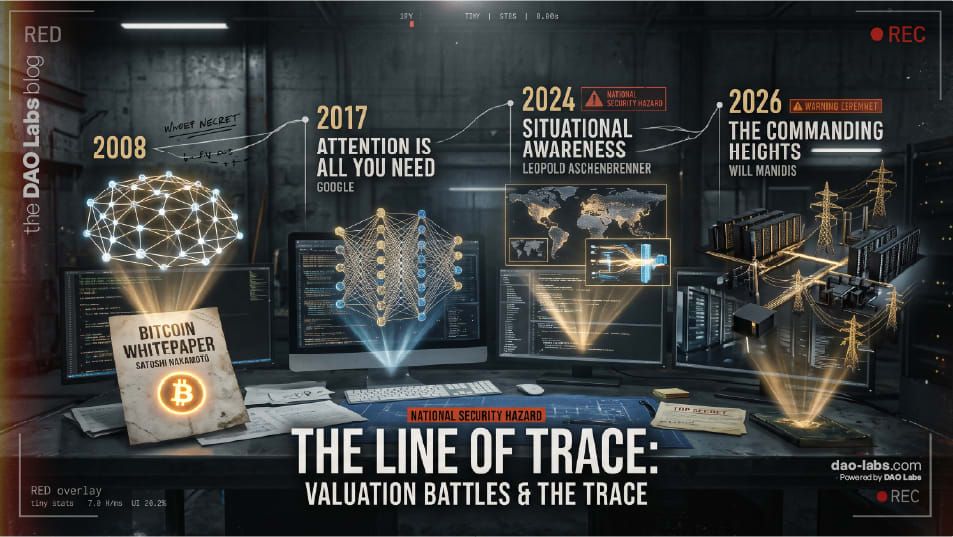
ATR.- For almost twenty years, the major leaps in the digital economy have first leaked to the world as low-key PDFs. If you paid attention to Satoshi Nakamoto’s 2008 Bitcoin Whitepaper, you anticipated the decentralized trust boom. If you caught Google’s 2017 Transformer paper, you witnessed the first steps toward generative AI. If you read Leopold Aschenbrenner’s 2024 "Situational Awareness" essay, you saw the blueprint for the trillion-dollar data center race.
Now, a new, heavily debated document by tech essayist and investor Will Manidis (founder of ScienceIO) and Joe Roberts—titled The Commanding Heights—has taken over the tech sector. This provocative manifesto poses a critical question for any miner, tech worker, or everyday investor: Are we about to watch the most highly valued companies in generative AI go flat-out broke?
The Timeline of Value-Capture (2008–2026)
This cinematic timeline illustrates the structural evolution of value, tracking how the foundational architecture of digital wealth has morphed from protocols to massive physical compute over the last twenty years, a historical lineage of these watershed, value-shifting documents is mapped out in this analysis:
1. The Gutenberg Curse: Why Model Labs May Go Broke
Many see frontier AI labs like OpenAI and Anthropic as sure bets. But Max Munro’s breakdown highlights a historical trap first felt by Johannes Gutenberg, the 15th-century inventor of the printing press. Gutenberg changed human communication forever—and went completely broke doing it.
Why? Because he built a massive piece of capital infrastructure that everyone else used to make their fortunes, while he was buried by the cost of scale and reproduction.
Today’s frontier AI labs face an even tougher version of this "Gutenberg Curse."
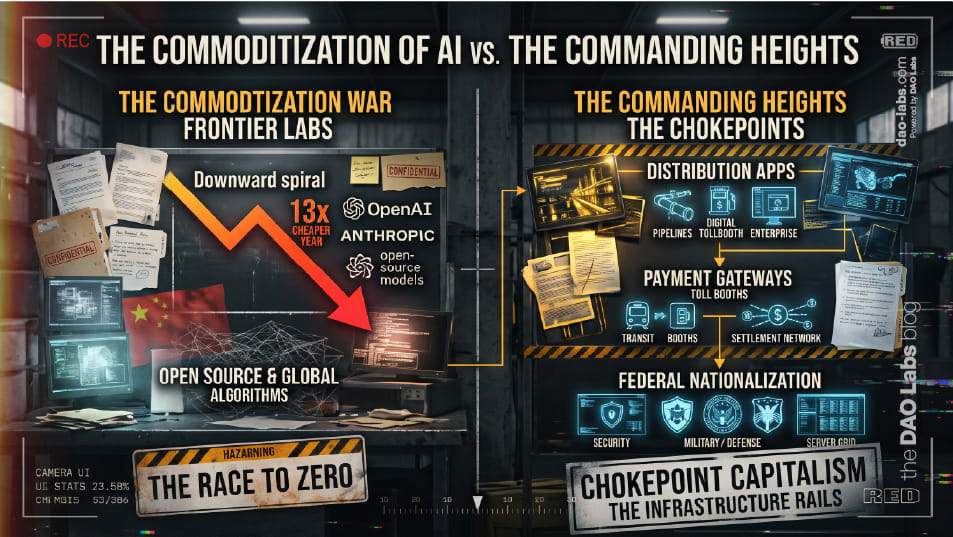
Plummeting Revenue Value: AI model capabilities get about 13 times cheaper every single year, driven down by relentless efficiency gains.
The Global Open-Source Avalanche: China’s open-source alternatives are commoditizing generative intelligence at a rapid pace. As Munro points out, "China gives its AI away for free because free AI is a weapon." When high-tier models cost pennies to use or are given away for free, the digital shelf life of proprietary software shrinks to months.
Insane Capital Requirements: While the sale value of intelligence falls, the cost to build it triples every year. No startup can sustain multi-billion-dollar R&D runs off $20/month consumer subscriptions.
2. The Coming Nationalization: Welcome to "Los Alamos AI"
If the major models are being commoditized and the labs cannot afford the next generation of compute, who pays the bills?
Manidis argues that Washington will have to step in. Nearly half of the S&P 500 is propped up by AI-driven speculation. If these companies collapse, it would directly impact the retirement funds of millions of everyday citizens—a crisis no president can allow.
The outcome? S&P 500 protection and geopolitical survival will force the state's hand, leading to the nationalization of frontier AI. Just like the U.S. government stepped in to shore up Intel with nearly 10% in funding via the CHIPS Act, the federal government is expected to absorb these labs.
Frontier AI labs won't exist as hyper-profitable software companies; they will become secure, sovereign military-scientific projects—essentially, a modern-day Los Alamos. The best minds will develop the most powerful intelligence on Earth behind closed government doors, while the everyday consumer applications become cheap, low-margin utilities.
3. Securing the "Commanding Heights" (The Real Chokepoints)
If the labs are going to be heavily regulated or run by the state, where does the actual, lasting wealth go?
Manidis' title comes from a famous 1922 speech by Vladimir Lenin during Soviet Russia's New Economic Policy. Lenin allowed small businesses to trade freely but insisted that the state retain control over the "Commanding Heights"—the railroads, heavy industry, and energy. If you own the physical transit pathways, it doesn't matter who is trading on them; they all have to pay your toll.
AI’s "commanding heights" aren't the brain-like models themselves. They are the inescapable physical, distributional, and financial bottlenecks:
Distribution Rails: The digital systems and interfaces that get AI to your screen.
Financial Infrastructure: The transactional pipelines, clearing networks, and payment systems that process every single dollar of compute.
Physical Capital: The energy grids, land, and fiber-optic pipelines that keep the data centers running.
The Battle Ground (Frontier Labs vs. Chokepoints)
This split-screen visualizer shows the contrast between the highly unstable model landscape and the fortified, Toll-style bottlenecks of the Commanding Heights:
What This Means For You
The message here is clear: stop looking at artificial intelligence as a software game and start looking at it as an infrastructure game. In the long run, the biggest winners won't be the companies creating the models. It will be the "boring" companies that own the tollbooths—the payment gateways, the critical distribution apps, the energy grids, and the sovereign supply lines that the entire digital economy has to pass through.
Are we investing in the future, or are we buying Gutenberg’s printing press right before it goes bust? Only the ones who control the commanding heights will survive.
Complete Citation and Reference Sheet (For Miners)
Analysis Video Source: The next trillion-dollar PDF (Max Munro, Oct 2026)
The Blueprint Whitepapers:
Supporting Evidence:
Federal funding and backstops for critical technology like Intel (The CHIPS Act)
Join the Revolution!
Get started with Social Mining today and become a vital part of our growing ecosystem.
Follow our channels:
🌐 Socials: Telegram • X • Reddit • Medium
🌎 Quick Links: DAO Labs • WhoTweets
Disclaimer: All information shared by DAO Labs is for educational purposes only. Crypto-related activities involve risk; please ensure you are compliant with the regulations in your jurisdiction before participating. Not financial or investment advice.